Final year is almost over. Your classmates are talking about offer letters, and you are sitting at home wondering what went wrong. Maybe your college has few drives. Maybe you missed the eligibility cut-off, or did not clear an online test. Maybe you graduated a while ago and the placement season is behind you. It is easy to feel that the door has closed.
It has not. Off-campus hiring is a normal, widely used route to a first job, and many freshers take it, including students from colleges with active placement cells. The difference is that nobody organises it for you. You have to find the openings, check your eligibility, prepare for the tests and manage the whole process yourself.
This guide compares off-campus vs on-campus placements honestly, shows what the 2026 data says, and then gives you a step-by-step plan to get a job without a campus drive, from finding openings to avoiding scams.
What This Guide Covers
• The real differences between on-campus and off-campus placements
• What 2026 hiring data says, and how to read it
• Who should go off-campus, and the myths that hold people back
• Eight ways to find off-campus openings
• How to build your proof, apply, prepare for the rounds and use referrals
• Online test tips, a worked example, how to compare offers and handle rejection
• How to spot fake offers, a 12-week campaign plan and FAQs
On-Campus vs Off-Campus: The Real Differences
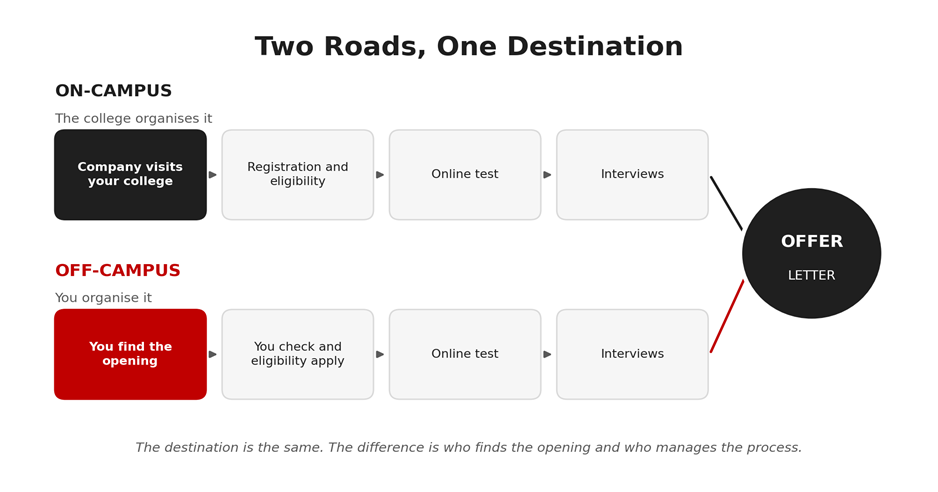
In an on-campus placement, companies come to your college through the placement cell, which handles registration, schedules and logistics. In an off-campus placement, you apply directly to a company, a drive or a job portal, without your college organising anything.
|
|
On-Campus |
Off-Campus |
|
Who organises it |
Your college placement cell |
You, with the company or a hiring platform |
|
Which companies |
Those your college attracts |
Any company that is hiring, in any city |
|
Eligibility and timing |
Set by the college and the company, in a fixed season |
Set by each company, with openings through the year |
|
Competition |
Students of your college |
Applicants from many colleges and cities |
|
Support |
Registration, schedules and coordination are handled |
You manage applications, tests and follow-ups yourself |
|
Flexibility |
Fewer options, and a clear calendar |
Many options, and no fixed calendar |
|
Main risk |
A thin list of companies, or missing the season |
Scams, scattered effort and slow feedback |
Neither route is automatically better. On-campus gives structure but fewer choices. Off-campus gives choice but demands self-discipline. The smartest approach is to treat them as two doors and walk through both.
What the 2026 Data Says
|
Reported data points (read with care) Employer intent: The TeamLease EdTech Career Outlook Report, based on a survey of 1,051 employers between November 2025 and January 2026, found that nearly 73% planned to hire freshers in the first half of 2026. Unplaced students: The Unstop Talent Report 2026, covering 37,000-plus students and 500-plus HR leaders, reported that 84% of undergraduates were still unplaced at the time of the survey. It also found that 64% of HR leaders said they define top talent by capabilities such as AI/ML, data, cloud and cybersecurity rather than by degree. Employability: The India Skills Report 2026 put overall employability at 56.35%, up from 54.81% a year earlier, with computer science engineers at 80% and IT engineers at 78%. GCCs: The Zinnov-Nasscom GCC Landscape 2026 counts 2,117 Global Capability Centres in India employing about 2.36 million professionals. How we read these: We read these figures in a 2026 compilation by ThePeoplesBoard that links to each original report. They come from different surveys with different samples and dates, so they do not form one connected statistic, and you should open the originals before quoting them. |
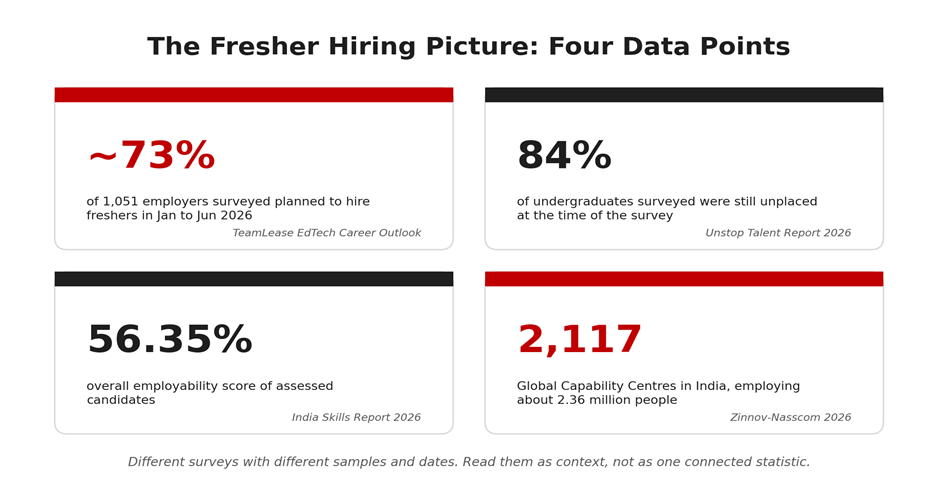
What do these numbers suggest when read together? Employers say they want freshers, yet many students are still waiting for an offer. That gap points to hiring that is selective rather than scarce: employers are looking for demonstrated skills, not only degrees. That is good news for off-campus candidates, because proof of skill is something you can build regardless of which college you attended.
Who Should Go Off-Campus?
Off-campus is not only for students whose colleges have no drives. It suits you if:
• Your college has few or no recruiters visiting.
• You missed a drive, did not clear a test, or did not meet an eligibility rule.
• You want a role, domain or company that does not visit your campus.
• You have already graduated and the campus season is over.
• You have cleared backlogs or finished a course and are ready to apply now.
• You are switching into IT from another stream.
Even if your college runs active drives, applying off-campus in parallel widens your options. Check your college's placement policy first, since some colleges have rules about students who hold offers.
Myths That Hold Freshers Back
• "Off-campus is only a backup plan." It is a standard hiring route for many freshers and companies. Treat it as a main channel, not as a consolation.
• "Only the top colleges get off-campus offers." Many employers screen on skills and tests. Your college name matters less than your proof, though some roles do set eligibility rules.
• "You need a referral or nothing works." Referrals help a lot, but plenty of freshers are hired through direct applications and drives.
• "Drives happen once a year." Off-campus openings appear throughout the year, which is why a steady routine beats a last-minute rush.
• "I must pay for training or registration." Never. Genuine employers do not charge candidates to hire them.
Eight Ways to Find Off-Campus Openings
Relying on one channel is the most common mistake. Use several, and check them on a schedule.
1. Company career pages
The official careers page is the most reliable source, and it is where fake listings cannot hide. Make a list of 20 to 30 target companies, bookmark their careers pages and check them weekly. Many roles appear here first or only here.
2. Job portals with fresher sections
Major job portals have sections or filters for freshers, trainees and graduates. Create a complete profile, set alerts with your exact target titles and city, and apply early. Check the portal's own current features before relying on them.
3. Professional networks
Follow your target companies, turn on job alerts, and read hiring posts from recruiters and employees. Connect with alumni from your college who work at those companies. Our article on why you may not be getting interview calls includes message templates.
4. Off-campus drive announcements
Companies announce off-campus drives on their own career pages and social accounts, and on hiring platforms. Always verify a drive on the company's official page before registering, and be careful with lookalike links.
5. Referrals and alumni
A referral works best when the person genuinely knows your work. Start with seniors, alumni, mentors and internship colleagues, and ask for advice, not a job. A short, specific, polite message beats a mass copy-paste.
6. Walk-ins and local drives
Walk-in drives still exist in IT hubs. Prepare as you would for a formal interview, carry documents, arrive early and confirm that the notice came from the company's official channel. Our Pune interview guide has a walk-in checklist.
7. Internships, trainee roles and apprenticeships
Internships, trainee programmes and apprenticeships can be a side door into a company. India has apprenticeship schemes backed by law and government programmes, and the government's Apprenticeship India portal lists opportunities. Even a short paid internship gives you real experience and a reference. Whether any of these lead to a full-time role depends on the company, so ask about conversion before you join.
8. Startups and Global Capability Centres
Startups often value projects and speed of learning over college names. GCCs, which are the in-house technology centres of global companies in India, tend to hire fewer freshers more selectively. Check their career pages directly, and prepare for tougher screening.
If You Are in Pune
Pune's IT employment is spread across clusters named in public city guides: Hinjewadi, Kharadi, Magarpatta, Talawade, and the Baner and Balewadi corridor. That spread helps off-campus candidates: you can attend local tech meetups, college alumni gatherings and walk-in drives, and build relationships face to face. Plan your commute before any in-person drive, and verify every walk-in notice with the company.
Build Your Off-Campus Proof Pack
Without a placement cell vouching for you, your proof does the talking. Prepare these items once, so you can apply quickly whenever an opening appears:
• A one-page resume in PDF, saved as Firstname_Lastname_Resume.pdf. See our guides on ATS resume mistakes and on why applications get rejected.
• A role card: your target role, six must-have skills, three proof points and the job titles to search.
• Two or three real projects on GitHub, with README files and live links where possible.
• A complete LinkedIn profile with a headline that names your target role and skills.
• Scanned documents ready: ID proof, mark sheets, degree or provisional certificate and any relevant certificates.
• A tracker to log every application, source, status and follow-up date.
How to Apply to an Off-Campus Drive
1. Read the eligibility first. Check the degree and branch, passing year, marks criteria, backlogs, location and any service agreement or bond.
2. Register through the official link from the company's careers page, not a forwarded message.
3. Tailor your resume to the role, using the job description's wording where it is true for you.
4. Apply early. Popular openings can attract very large numbers of applicants.
5. Prepare for the typical rounds. Many processes include an online test (aptitude, reasoning and sometimes coding), a technical interview and an HR round.
6. Track and follow up. Record the date, note the stated timeline and send one polite follow-up if you hear nothing.
Prepare for the Rounds
Off-campus processes vary by company, but the preparation is predictable.
• Aptitude and reasoning: practise short, timed sets every day. Cover percentages, ratios, series, logical reasoning and reading comprehension.
• Coding and technical basics: practise the core programs and SQL queries that fresher interviews repeat. See our guides to the top 15 Java programs and to 15 SQL queries for freshers.
• Projects: be able to explain every project you list, including one problem and its fix.
• HR and communication: prepare your introduction, your answers on relocation and shifts, and your questions for the interviewer. See our Pune interview guide.
Treat every failed test as data. Write down the topics you struggled with, and fix them before the next one.
How to Handle Online Assessments
For many off-campus drives, the online test is the first real filter, and it is where good candidates lose out by being unprepared for the format. A few habits make a large difference:
• Read the instructions fully. Note the number of sections, the time for each, whether there is negative marking and whether you can go back.
• Manage time per question. If a question is taking too long, mark it and move on. Returning later is better than losing five minutes on one item.
• In coding sections, get something working first. Many platforms award marks for passing some test cases, so a correct simple solution beats an unfinished perfect one. Check edge cases such as empty input, zero and duplicates.
• Follow the rules. Online tests are often proctored. Keep your camera and microphone working, avoid switching tabs, and use a quiet room with stable internet.
• Do a dry run. Take a timed practice test on the same kind of platform before the real one.
The First 30 Minutes After You See an Opening
Speed matters, but so does accuracy. When you spot an off-campus opening, work through this short routine instead of clicking Apply in a rush:
1. Verify it. Find the same opening on the company's official careers page.
2. Read the eligibility. Check the degree, passing year, marks, backlogs, location and any bond.
3. Match your skills. Compare the must-have skills with your role card, and decide honestly whether to apply.
4. Tailor your resume. Adjust the summary and skills section using the job description's wording where it is true.
5. Apply through the official link, and keep a copy of the confirmation.
6. Log it. Add the company, role, date, source and a follow-up date to your tracker.
A Worked Example (Fictional)
|
Illustrative example: a fresher with no campus drives Situation: Meera is a final-year BCA student at a college with no IT recruiters. She is based in Pune and wants a software or testing role. Week 1: She picks two target roles (junior Java developer and QA trainee), writes a role card for each and rewrites her resume to one page with a summary line for the Java role. Weeks 2 to 4: She builds one project properly, a simple student-attendance app, puts it on GitHub with a README and a short demo video, and sets up job alerts with her exact role titles and city. Weeks 3 to 8: She applies early to well-matched roles three days a week, sends two personalised messages a week to alumni of her college, and attends one local meetup a month. She logs everything in her tracker. Weeks 6 onwards: She practises timed aptitude sets and does mock interviews with a friend, reviewing her tracker every Sunday and changing one thing at a time. This example describes a process, not a result. Outcomes depend on the market, the role and the candidate, and nobody can guarantee a job. What it shows is a plan that a fresher can follow without any help from a placement cell. |
Plan It: A 12-Week Off-Campus Campaign
Without a plan, off-campus hunting becomes scattered scrolling. This 12-week structure keeps the pieces moving together.
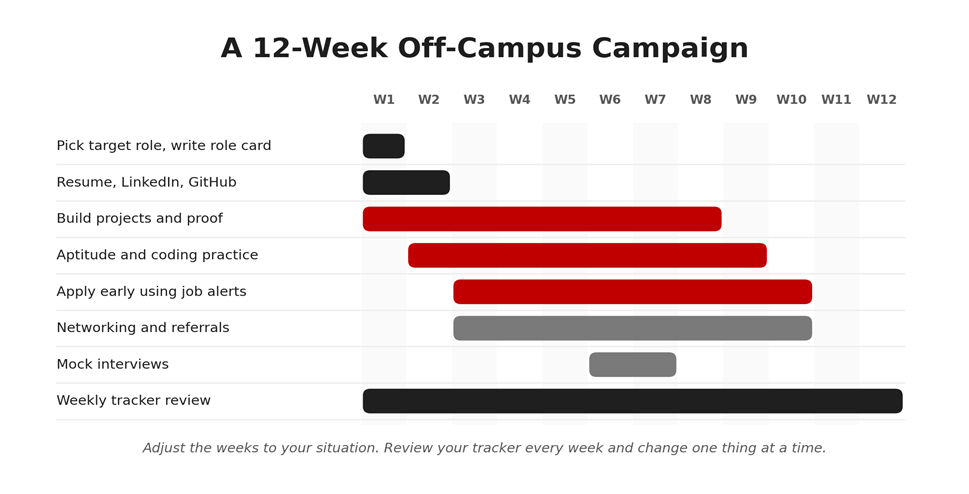
• Weeks 1 and 2: choose your target role, write your role card, fix your resume, LinkedIn and GitHub, and set up the tracker.
• Weeks 3 to 5: switch on job alerts, start applying early to well-matched roles, send your first personalised messages and begin daily aptitude and coding practice.
• Weeks 6 and 7: add mock interviews, ask for feedback on your resume and projects, and review your tracker.
• Weeks 8 to 10: keep applying and networking, finish your main project, and follow up on older applications.
• Weeks 11 and 12: review your response rate, change one variable, and plan the next cycle.
Beware of Fake Offers and Interview Scams
Because off-campus hunting happens outside your college's protection, fraudsters target freshers aggressively. Learn the red flags and share them with friends.
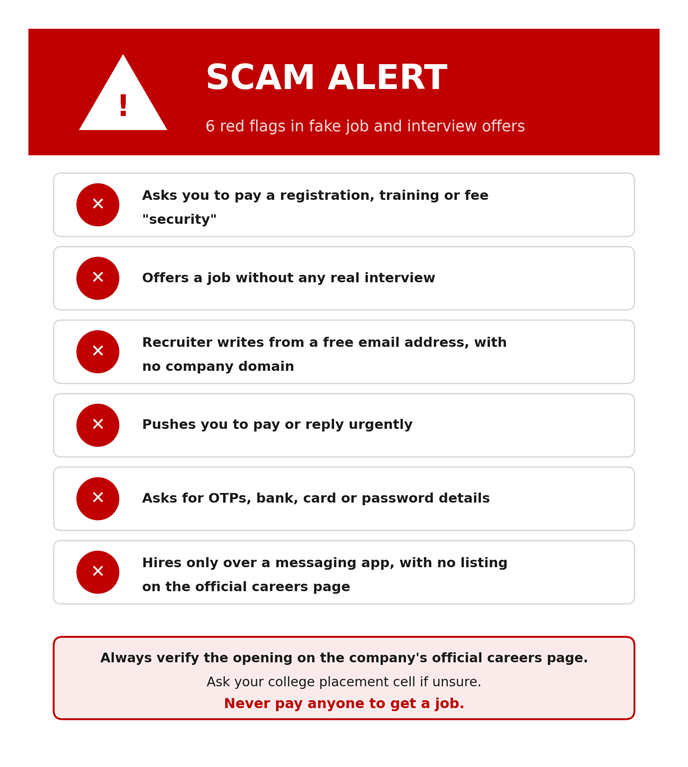
If anything feels wrong, stop, verify the opening on the company's official careers page and ask your placement cell, a senior or a mentor before replying.
How to Evaluate an Offer
When an offer arrives, slow down and read it carefully, especially in off-campus hiring, where you are the one checking its authenticity. Before you accept, confirm the following:
• Authenticity: the offer comes from an email on the company's own domain, and the company and the role appear on its official careers page. You can also ask HR to confirm through an official contact.
• Role and location: the job title, the work location and the joining date match what was discussed.
• Compensation structure: the split between fixed pay, variable pay and benefits is stated clearly.
• Terms: probation period, notice period and any service agreement or bond, including its duration and any amount involved.
• Learning: what training or onboarding you will receive and what you will actually work on.
If something is unclear, ask in writing and keep the reply. A genuine employer will answer without pressure, and will never ask you to pay anything to receive or confirm the offer.
Do Not Ignore Campus Drives If You Have Them
Choosing off-campus does not mean giving up on campus. If your college runs drives, register for the ones that fit you, prepare for them and apply off-campus in parallel to companies your campus does not attract. A campus offer reduces pressure, and an off-campus pipeline gives you options. Just check your college's policy on holding multiple offers.
Handling Rejections and Failed Tests
Off-campus hunting involves many more rejections and silences than a campus drive, simply because you apply to more places. Expect it, and build a loop that turns each one into progress:
1. Write down what happened straight after the test or interview: the questions, the topics and how you felt.
2. Find the pattern. After a few attempts, the same topics or stages tend to repeat. That is your real study list.
3. Fix one weakness at a time with focused practice, instead of studying everything again.
4. Check the reapplication rule. Many companies set a waiting period before you can reapply, so use that time to improve.
5. Protect your energy. Take a rest day each week and talk to a mentor or friend. A tired candidate performs worse.
Common Off-Campus Mistakes
• Applying everywhere without a target role. Focus beats volume.
• Using one channel only. Combine career pages, portals, networks and referrals.
• Applying late to popular openings.
• Ignoring eligibility criteria, which wastes applications.
• Registering through unverified links. Always start from the official careers page.
• Not tracking results, so nothing improves.
• Stopping after a few rejections. Treat each one as feedback and adjust.
Where Structured Guidance Can Help
Going off-campus means managing your own preparation, projects and feedback. If you would like guided support, a learning centre such as upGrad Learning Support Centre, Pune can be a useful next step to explore, especially if you want structured practice, project work and interview preparation.
Structured programmes in areas like data, AI/ML, full stack development and digital marketing generally combine a planned curriculum, hands-on projects, mentor guidance and interview preparation. Course content, fees, schedules and eligibility can change, so confirm the latest details directly with the centre.
Before joining any programme, ask whether you will build real projects and get feedback on them, whether resume reviews and mock interviews are included, and whether the curriculum matches what employers ask for today. Be cautious about anyone who guarantees a job, interviews or a salary, because nobody can honestly promise that.
Get Regular Job Updates
Looking for regular IT job updates, fresher opportunities, and career-related updates? Join our WhatsApp group for more job updates and opportunities.
Join our WhatsApp Group: https://chat.whatsapp.com/KA8HpgjbJ67I5yfQDquCvn
Frequently Asked Questions (FAQs)
Q. Is off-campus placement harder than on-campus?
It is different, not necessarily harder. You manage more yourself and compete with applicants from many colleges, but you also have far more choices. Preparation and proof matter more than the route.
Q. Can I apply off-campus if my college has placement drives?
Generally yes, but check your college's placement policy first, because some colleges have rules about students who hold or decline offers.
Q. Do off-campus drives have a marks cut-off?
Many postings state eligibility criteria such as degree, passing year and marks, while some rely more on tests. Always read the eligibility section before applying.
Q. When do off-campus drives happen?
Openings appear throughout the year rather than in a single season, so build a steady routine of checking career pages, alerts and networks.
Q. How many applications should I send?
There is no fixed number. Focus on well-matched, early and tailored applications, and track your response rate to see what works.
Q. Are off-campus offers as good as campus offers?
It depends on the company and the role, not on the route. Compare the role, learning, location and terms of each offer, and read the offer letter carefully.
Q. How do I avoid off-campus job scams?
Never pay a fee, verify every opening on the official careers page, be wary of free email addresses and messaging-app-only hiring, and never share OTPs or bank details.
Q. Is a gap after graduation a problem?
It can raise questions, but you can answer them. Explain honestly, and show what you did during the gap, such as projects, courses or an internship.
Conclusion
The choice between off-campus vs on-campus placements is not a choice between success and failure. Campus drives give structure and convenience. Off-campus gives reach and control, but only if you build proof, use many channels, apply early, prepare for the rounds and stay alert to scams. The 2026 data suggests that employers still want freshers, and that they are looking for demonstrated skills.
Your next step is simple. Write your role card today, set up your tracker and start the first two weeks of the campaign plan. If you want mentor feedback and structured practice, you can also explore what upGrad Learning Support Centre, Pune offers for your chosen path.
And if you want regular job and fresher opportunity updates, use the WhatsApp group link in the "Get Regular Job Updates" section above.