
A Strategic Blueprint for Freshers and Graduates
The Big Three of the 2026 Tech Industry
The technology landscape has aggressively consolidated around three major pillars in 2026. While niche skills like cybersecurity and cloud infrastructure remain vital, the overwhelming majority of entry-level hiring, innovation, and corporate investment is currently pouring into Full Stack Development, Data Science, and Artificial Intelligence (AI).
For freshers, trying to learn a little bit of everything is no longer a viable strategy. Companies are seeking specialized talent who can immediately contribute to specific project pipelines. Selecting one of these three primary paths provides clarity, structure, and the highest probability of securing a robust, future-proof IT career.
Market Demand & Salary Breakdown (2026)
Understanding the macro-level demand is critical before investing months into learning a technology. The pie chart below illustrates how entry-level hiring is currently distributed among these three dominant domains.
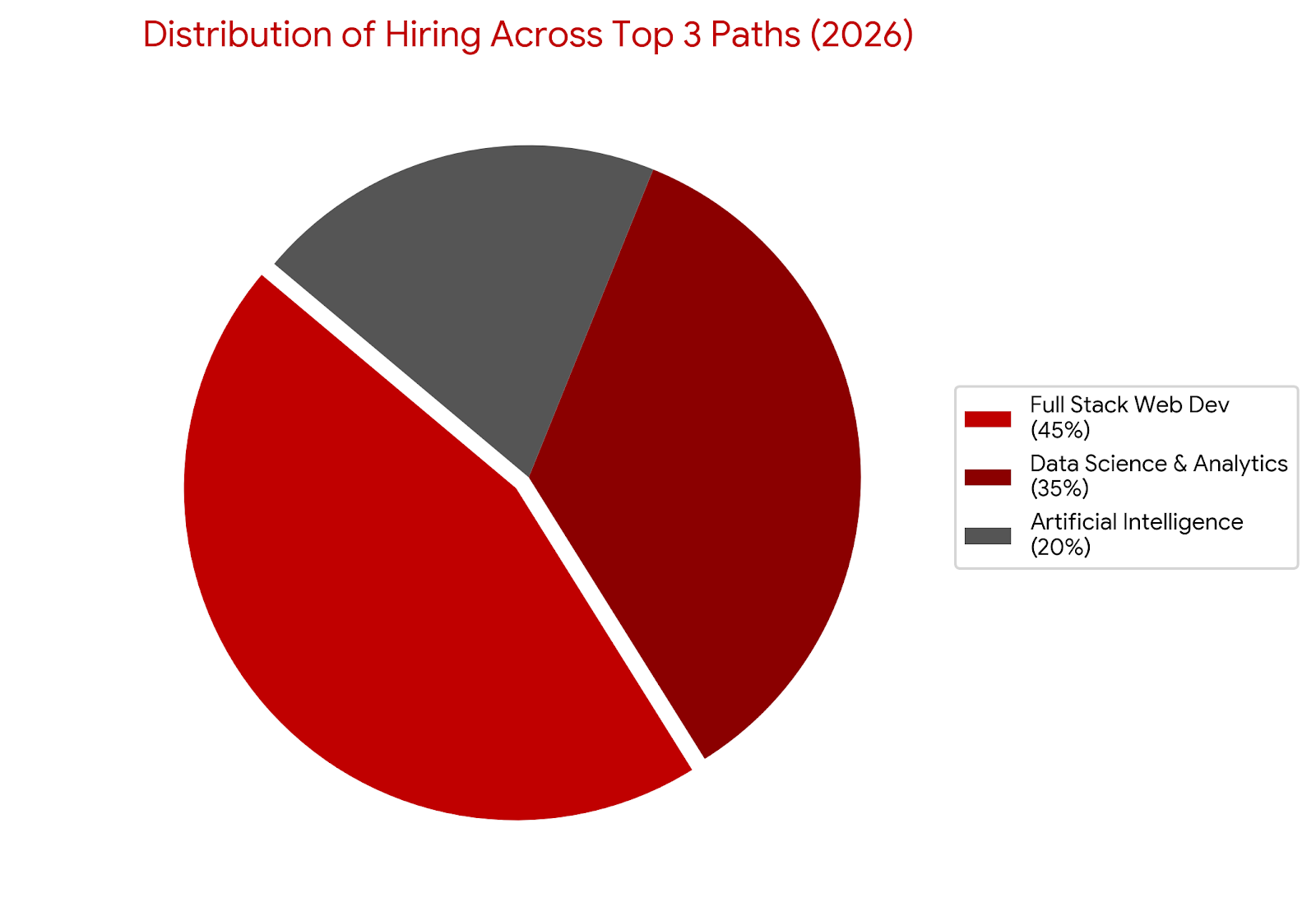
· Full Stack Development commands a massive volume of available jobs and typically offers entry-level salaries ranging from ₹5–18 LPA in India.
· Data Science & Analytics is rapidly catching up as enterprises mandate data-driven workflows, with salary potentials of ₹8–20 LPA.
· Artificial Intelligence (AI & ML) represents the most rapidly emerging demand, boasting premium salary potentials between ₹10–25 LPA in India.
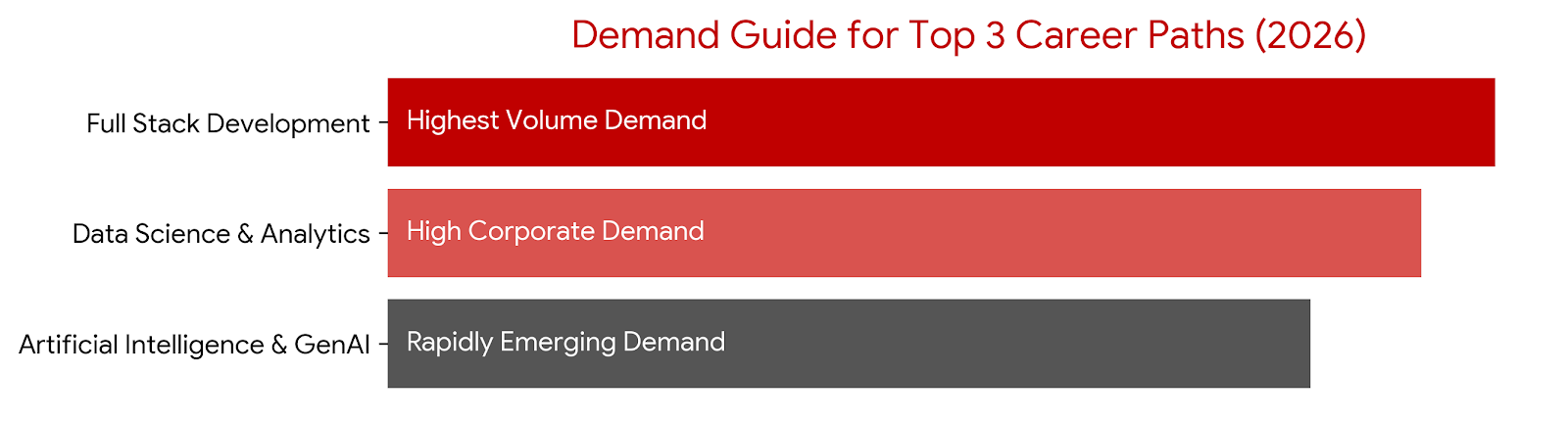
Career Path Demand Guide
While all three paths are highly lucrative, the nature of their industry demand differs. Here is how recruiters view these specific skill sets today.
Deep Dive: The Top 3 Career Paths
1. Full Stack Web & Application Development
Every business, from local startups to global banks, requires a digital presence. Full Stack Developers are the architects of the web, capable of building user-facing interfaces (frontend), managing the server-side logic (backend), and structuring data storage (database).
· Frontend Frameworks: React, Angular, or Vue.js for building dynamic user interfaces.
· Backend Architecture: Node.js, Express, or Java Spring Boot.
· Database Management: Structuring data using SQL (PostgreSQL/MySQL) or NoSQL (MongoDB).
· Target Roles: Software Engineer, Full Stack Developer, Web Application Developer.
· Ideal Candidate Profile: Graduates who enjoy immediate visual feedback from their code, logical problem-solving, and building tangible products from scratch.
2. Data Science & Analytics
Modern businesses generate massive amounts of data. The role of a Data Scientist or Analyst is to clean, process, and analyze this data to predict future trends and guide executive decision-making. Developing a strong foundation in the joy of computing using Python is highly advantageous here, as it forms the bedrock of data manipulation.
· Programming & Manipulation: Advanced Python, Pandas, and NumPy.
· Statistical Modeling: Probability, descriptive statistics, and Machine Learning algorithms.
· Visualization & BI: Creating dynamic dashboards using Tableau, Power BI, and advanced SQL.
· Target Roles: Data Scientist, Data Analyst, Machine Learning Engineer.
· Ideal Candidate Profile: Individuals with an analytical mindset, a strong affinity for numbers, patterns, and uncovering the hidden stories within massive datasets.
3. Artificial Intelligence & Generative AI
No longer confined to research labs, AI is now an operational necessity. Careers in this path focus on integrating Large Language Models (LLMs), automating cognitive tasks, and building intelligent agents that can interact with users naturally.
· AI Integration: Leveraging OpenAI APIs, LangChain, and Hugging Face.
· Prompt Engineering: Structuring complex inputs to generate highly accurate AI outputs.
· AI-Assisted Automation: Building intelligent workflows that replace manual processes.
· Target Roles: AI Engineer, Prompt Engineer, Automation Specialist.
· Ideal Candidate Profile: Forward-thinking graduates who want to be at the absolute cutting edge of technology and enjoy experimenting with the latest models and automation techniques.
The 90-Day Sprint to Job Readiness
Regardless of the path you choose, a structured 90-day learning sprint is the most efficient way to become job-ready:
Phase 1: Foundation (Days 1–30)
Dedicate your first month entirely to syntax and core principles. Master your primary language (JavaScript for Full Stack, Python for Data/AI) before touching complex frameworks.
Phase 2: Frameworks & Tools (Days 31–60)
Introduce industry tools. Learn React, Pandas, or LangChain depending on your path. Combine these tools with Git/GitHub to start version-controlling your practice code.
Phase 3: Portfolio & Preparation (Days 61–90)
Build two original projects from scratch. Optimize your LinkedIn profile and begin practicing mock technical interviews specific to your domain.
Accelerating Your Career in Pune
For graduates based in Pune—one of India's preeminent IT hubs—transitioning from academic learning to professional readiness requires the right environment. While self-learning is possible, it often leads to critical gaps in practical knowledge.
For those seeking a structured, professional, classroom-based environment, upGrad Learning Support Centre Pune offers highly specialized programs. With accessible centers in Kothrud and Wakad, upGrad provides instructor-led training tailored specifically for fresh graduates in all three major paths: Full Stack Development, Data Science, and Artificial Intelligence.
· In-person instructor support to resolve complex coding logic doubts instantly.
· Guided, live projects that simulate real corporate IT environments.
· Dedicated career services, including resume optimization and interview coaching.
By stepping out of isolated online learning and entering a collaborative peer environment, freshers can significantly accelerate their job readiness.