
You have sent forty applications. Your inbox shows nothing, or worse, a polite rejection that says nothing useful. It is easy to decide that "the market is bad" or "the software rejected me". Sometimes that is partly true. More often, there are specific, fixable reasons why job applications get rejected before anyone ever speaks to you.
This guide is for students, final-year graduates, freshers and career switchers who are applying for IT and non-IT roles and not getting interview calls. It explains what actually happens after you click Apply, then walks through 10 common fresher problems, what a recruiter sees in each, and exactly how to fix it.
You will also get a before-and-after resume table, a self-audit checklist and a 7-day fix plan you can start today.
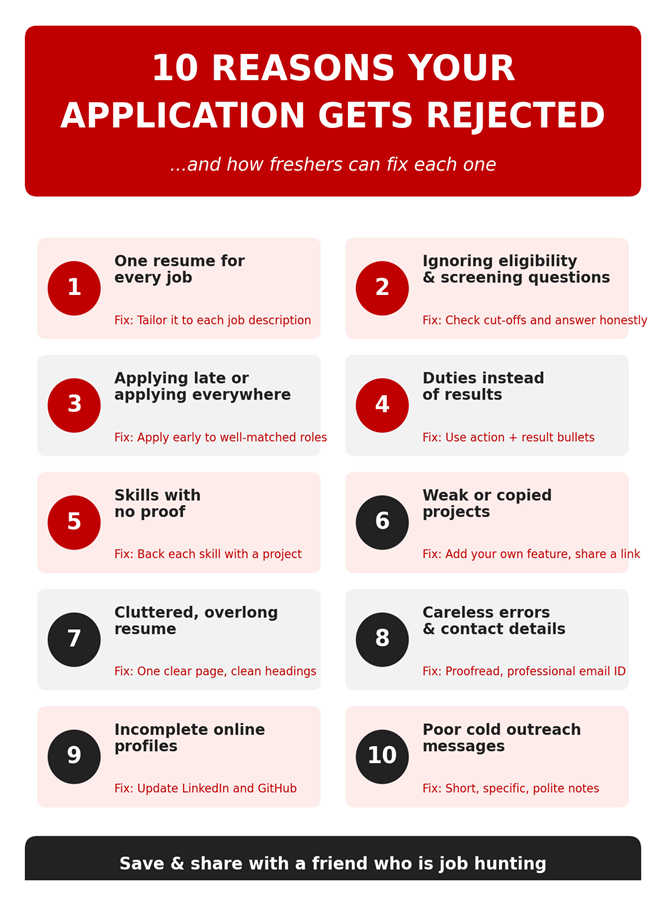
Figure: 10 reasons applications get rejected, with a fix for each (save and share)
What Really Happens After You Click Apply
Most freshers imagine a robot reading their resume and throwing it away. The reality is more ordinary, and understanding it helps you fix the right things.
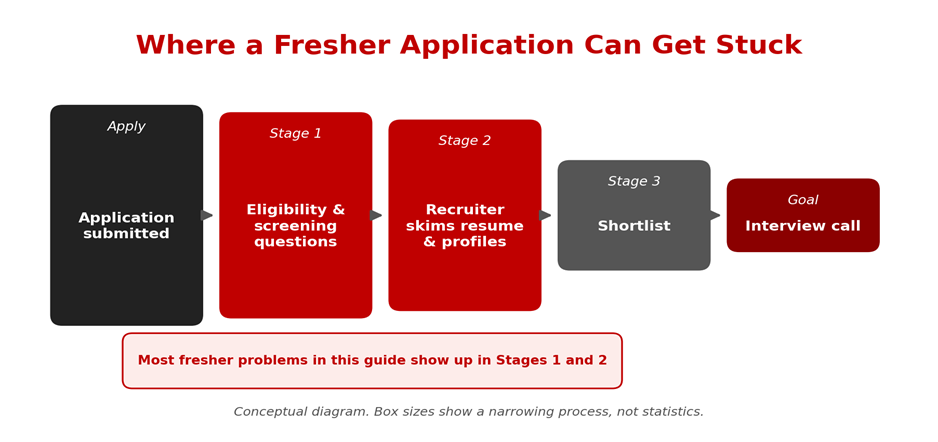
When you submit an application, it usually passes through three stages. First, your answers to eligibility and screening questions are checked. Second, a recruiter skims your resume and online profiles. Third, a shortlist is created from the people who stood out. Rejection can happen at any of these points, but the first two are where freshers lose most opportunities.
|
Verified fact: what a recent recruiter survey found A survey by the resume-tool company Enhancv spoke to 25 US-based recruiters. 92% (23 of 25) said their applicant tracking system does not automatically reject resumes because of formatting, design or content. Only 8% (2 of 25) had switched on content-based auto-rejection. The same research reports that a single job posting can attract roughly 400 to over 2,000 applicants, and that about 52% of recruiters said applying within the first 48 to 72 hours improves the chance of being reviewed. Read with care: the sample is small, it is US-based and it was run by a company that sells resume tools. Hiring in India, especially bulk and campus drives, can work differently. Treat this as an indicator, not a rule. Source: Enhancv, "Does the ATS Reject Your Resume?" (enhancv.com/blog/does-ats-reject-resumes). |
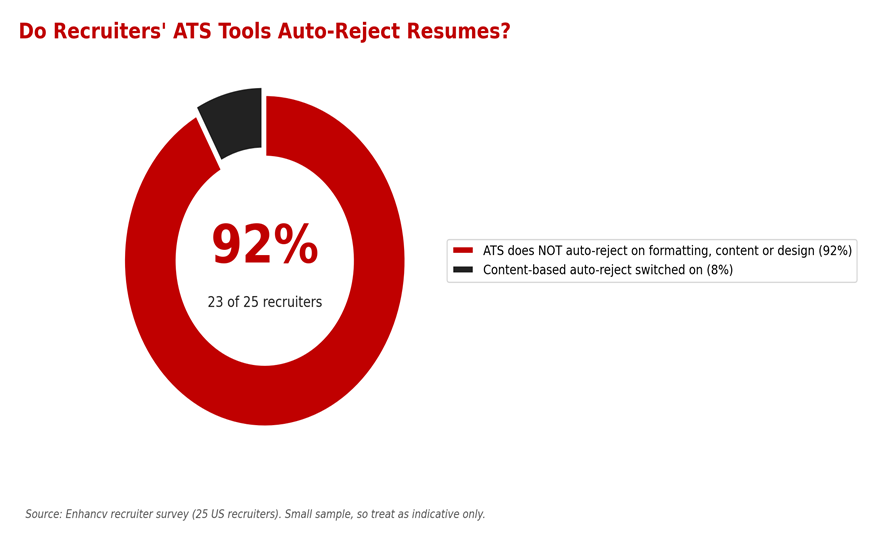
What does this mean for you? It suggests that many rejections are not caused by a machine silently deleting your file. They come from eligibility filters you did not meet and from busy humans skimming a very large pile and moving on quickly. That is good news, because both are things you can influence.
The 10 Problems at a Glance
|
# |
Problem |
What the Recruiter Sees |
Quick Fix |
|
1 |
One resume for every job |
A profile that does not match our role |
Tailor to each job description |
|
2 |
Ignoring eligibility and screening questions |
Does not meet basic criteria |
Check cut-offs, passing year and answers |
|
3 |
Applying late or applying everywhere |
Buried in the pile or a poor fit |
Apply early to well-matched roles |
|
4 |
Duties instead of results |
No evidence of ability |
Use action + result bullets |
|
5 |
Skills with no proof |
Claims we cannot verify |
Link each skill to a project |
|
6 |
Weak or copied projects |
Tutorial clone, nothing original |
Add your own feature and a live link |
|
7 |
Cluttered, overlong resume |
Hard to skim in a short time |
One clean page with clear headings |
|
8 |
Careless errors and contact details |
Lack of attention to detail |
Proofread, professional email ID |
|
9 |
Incomplete online profiles |
Nothing to verify the resume |
Update LinkedIn and GitHub |
|
10 |
Poor cold outreach |
Generic, unclear request |
Short, specific, polite messages |
The 10 Common Fresher Problems and How to Fix Them
Problem 1: Sending the Same Resume to Every Job
This is the most common mistake. A single, general resume is quick to send, but it forces the recruiter to work out why you fit. Most will not bother when hundreds of other people applied.
What the recruiter sees: A resume that never mentions the tools, skills or role in the job description.
How to fix it:
• Read the job description and highlight the top five skills it asks for.
• Move the matching skills and projects to the top of your resume.
• Mirror the role title honestly, for example "Python Developer Fresher" if that is the target.
• Keep a master resume and make a quick tailored copy for each application.
Problem 2: Ignoring Eligibility Criteria and Screening Questions
Many applications ask about your passing year, degree, percentage cut-off, backlogs, location or notice period. If your answers do not meet the stated criteria, the application can be filtered out before anyone reads your resume.
What the recruiter sees: A "no" or a mismatch on a basic requirement.
How to fix it:
• Read the eligibility section before you apply, not after.
• Answer screening questions honestly and carefully. A wrong or careless answer can end your application.
• If you are slightly outside the criteria, look for roles where you do fit instead of hoping the rule will be ignored.
• Keep your marks, passing year and documents ready so you can answer accurately.
Problem 3: Applying Late or Applying Everywhere
Popular roles can attract hundreds of applications within days. Applying a week late means competing for attention with a pile already reviewed. At the other extreme, applying to every job you see, whether or not you fit, wastes time and weakens your focus.
What the recruiter sees: Either an application near the bottom of a long queue, or a profile clearly aimed at a different role.
How to fix it:
• Turn on job alerts and apply within the first day or two for roles you genuinely match.
• Aim for quality: five well-tailored applications beat thirty copy-paste ones.
• Track every application in a simple sheet with the date, role, link and status.
• Follow up politely once after a week if a contact is available.
Problem 4: Describing Duties Instead of Results
Lines like "Responsible for developing a website" tell a recruiter nothing about quality. Fresher resumes become convincing when each line shows what you did, with which tools, and what happened as a result.
What the recruiter sees: Vague, generic lines that could belong to anyone.
How to fix it:
• Start each bullet with an action verb such as built, designed, tested or analysed.
• Name the tools you used.
• Add a result, even a small one: speed, users, features, accuracy or time saved.
• Only include numbers that are true and that you can explain.
Problem 5: Listing Skills Without Proof
A long skills section with twenty technologies looks impressive until the interviewer asks about one of them. Skills you cannot demonstrate can hurt your credibility, because they make the rest of the resume harder to trust.
What the recruiter sees: A keyword dump with no projects, links or context behind it.
How to fix it:
• List only skills you could discuss for five minutes in an interview.
• Group them by type, such as languages, databases and tools.
• Connect at least your top three skills to a specific project.
• Be honest about your level. "Basic" is fine and is better than an overclaim.
Problem 6: Weak or Copied Projects
Many freshers submit the same tutorial projects: a to-do app, a calculator, a clone of a famous website. These show you can follow instructions, but not that you can solve a problem. Recruiters see them often.
What the recruiter sees: A familiar project with no explanation, no link and nothing that is yours.
How to fix it:
• Pick one project and add a feature of your own that the tutorial did not include.
• Deploy it or record a short demo, and add a link.
• Write a README explaining the problem, the tools, how to run it and what you learned.
• Be ready to explain every design decision and one thing that went wrong.
Problem 7: A Cluttered or Overlong Resume
Recruiters often skim. A three-page resume with tiny fonts, long paragraphs and decorative graphics makes the important parts hard to find. The recruiter survey cited above suggests formatting rarely triggers automatic rejection, but a human still has to read it quickly.
What the recruiter sees: A wall of text where the strongest evidence is hidden.
How to fix it:
• Keep it to one page as a fresher, with clear section headings.
• Use a simple, readable font and consistent spacing.
• Put your strongest section (usually projects or skills) near the top.
• Save and send as PDF unless the application asks for another format.
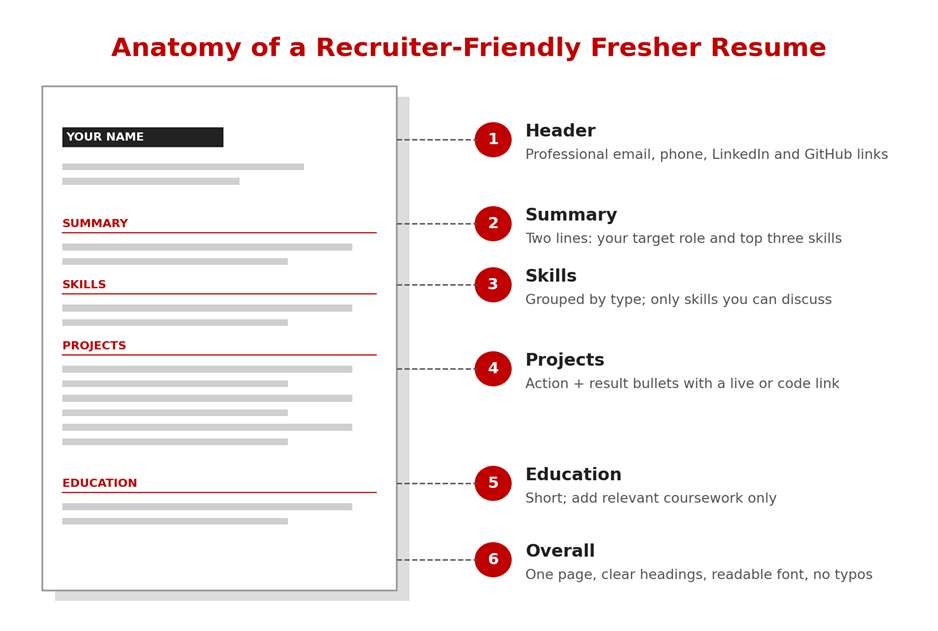
Figure: Anatomy of a recruiter-friendly fresher resume
Problem 8: Careless Errors and Poor Contact Details
Spelling mistakes, inconsistent dates, a broken link or an unprofessional email address such as "cooldude123@..." give the impression that you may be careless. Small errors can reduce trust quickly when a recruiter is choosing between similar candidates.
What the recruiter sees: Typos, mismatched details or contact information that looks unprofessional or does not work.
How to fix it:
• Use an email ID based on your name.
• Check that every link opens and that your phone number is correct.
• Read the resume aloud, then ask a friend to proofread it.
• Use consistent date formats, tense and bullet style.
Problem 9: Incomplete or Inconsistent Online Profiles
After reading your resume, a recruiter may open your LinkedIn or GitHub. An empty profile, an abandoned repository or details that do not match the resume raises doubts. A tidy profile, on the other hand, quietly confirms your claims.
What the recruiter sees: A resume with links that lead to empty or messy pages.
How to fix it:
• Add a clear photo (if you use one), headline and short summary to LinkedIn.
• Pin your best three repositories on GitHub with proper README files.
• Make sure titles, dates and skills match your resume.
• Remove or hide unfinished or irrelevant repositories.
Problem 10: Poor Cold Outreach and Application Messages
Messages such as "Sir, please give me a job" or a one-line email with the resume attached rarely get a reply. Where a short note or message is allowed, a clear and specific one can make you easier to remember.
What the recruiter sees: A generic, unclear message that does not say who you are or what you are asking for.
How to fix it:
• Keep it to four or five lines: who you are, the role, one relevant project, and a polite request.
• Use the recipient's name and mention the exact role or job ID.
• Attach a PDF resume named clearly, such as Firstname_Lastname_Resume.pdf.
• Do not send the same message to fifty people at once. Personalise it.
Which Problem Should You Fix First?
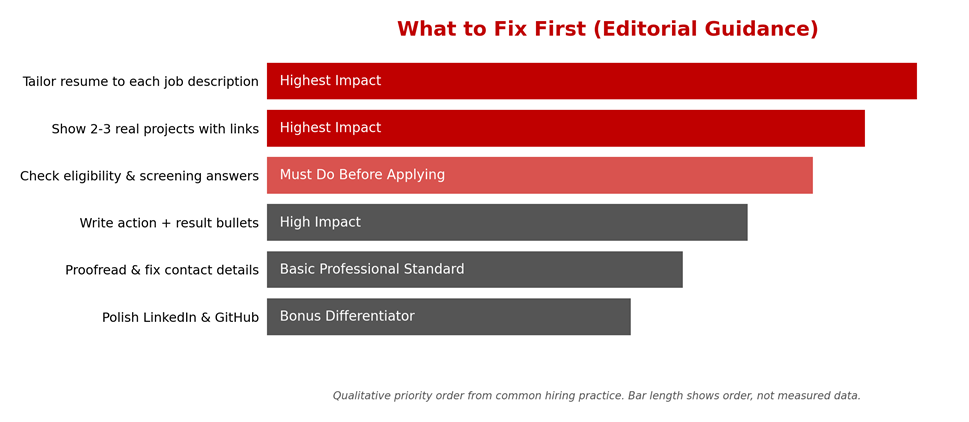
You do not have to fix everything at once. If you are not getting any calls, start with the changes that give the largest improvement for the least effort. The chart below shows a suggested order based on common hiring practice.
Your 7-Day Plan to Fix Your Applications
Set aside one to two hours a day for a week. By the end, you will have a stronger resume, tidier profiles and a clearer way to apply.
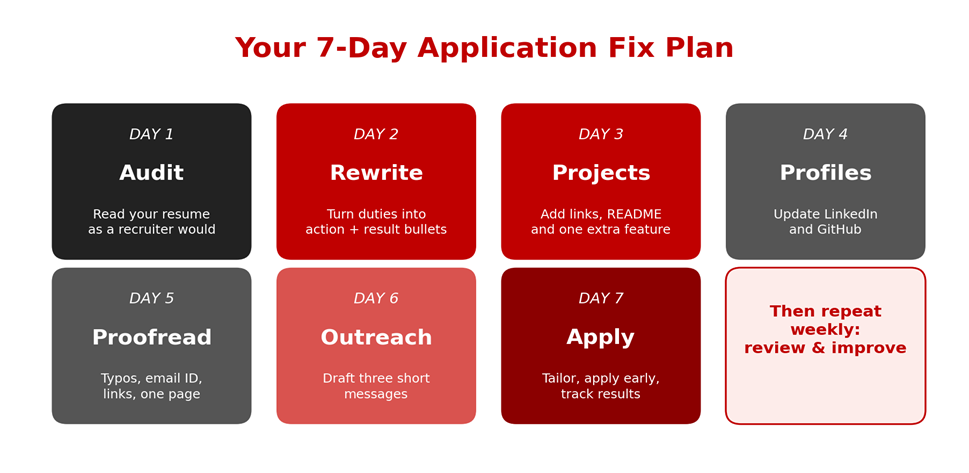
Figure: Your 7-day application fix plan
|
Day |
Task |
Output |
|
Day 1 |
Audit: read your resume as a recruiter would and list weak points |
A list of fixes |
|
Day 2 |
Rewrite bullets into action + result lines |
Updated experience and project sections |
|
Day 3 |
Improve one project: add a feature, README and a link |
One strong, shareable project |
|
Day 4 |
Update LinkedIn and GitHub so they match the resume |
Consistent profiles |
|
Day 5 |
Proofread, check links, fix email ID, reduce to one page |
A clean master resume (PDF) |
|
Day 6 |
Draft three short outreach messages |
Ready-to-use templates |
|
Day 7 |
Tailor and apply to five well-matched roles, then log them |
First five tracked applications |
Resume Self-Audit Checklist
Before you press Apply on the next job, check each point. Any "no" is a quick improvement.
• My resume matches the top skills in this specific job description.
• I meet the stated eligibility criteria, and my screening answers are accurate.
• Every bullet begins with an action and shows a result or outcome.
• Each listed skill is connected to a project or other proof.
• My top project has a live link or a GitHub link with a README.
• The resume is one page, with consistent fonts and headings.
• I have proofread it twice and a friend has checked it.
• My email ID is professional and my phone number is correct.
• My LinkedIn and GitHub match the resume and have no broken links.
• The file is a PDF named with my name.
• I am applying early, not weeks after the job was posted.
• I have recorded this application in my tracking sheet.
What to Highlight for Different IT Roles
Recruiters look for different proof depending on the role. Use this table to decide what should appear near the top of your resume. It is general guidance, and each company has its own priorities.
|
Target Role |
What to Highlight |
Proof That Helps |
|
Software / Web Developer |
Programming language, SQL, Git, one full-stack project |
Deployed app and clean GitHub |
|
Data Analyst |
SQL, Excel, a dashboard tool, Python basics |
Published dashboard with written insights |
|
AI / ML Trainee |
Python, ML basics, one prediction project |
Notebook with an explanation of errors |
|
Cloud / DevOps Trainee |
Linux, cloud basics, Git, CI/CD idea |
Hosted project with a short architecture note |
|
QA / Test Engineer |
Test case design, defect reporting, basic automation |
Sample test cases and a bug report |
|
Support / Non-coding IT |
Communication, troubleshooting, networking basics |
Documented problem-solving examples |
Myths vs Reality: What Freshers Often Believe
|
Common Belief |
More Accurate View |
|
"The ATS automatically deletes my resume." |
In the recruiter survey cited above, most said their system did not auto-reject on formatting or content. Eligibility questions and crowded queues are bigger factors. Keep your resume clean anyway, because a human still has to read it. |
|
"More certificates mean more interviews." |
Certificates can help, but projects and clear explanations usually persuade more. Use certificates as support, not as the main proof. |
|
"Applying to hundreds of jobs guarantees a call." |
Volume without fit tends to produce silence. Targeted, tailored applications are usually more effective. |
|
"My resume should list every skill I know." |
A focused resume is easier to trust. List what you can discuss and show proof for it. |
|
"A short message to a recruiter is pointless." |
A short, specific and polite message can help when it is allowed, but a generic one rarely does. |
Where Structured Guidance Can Help
Fixing these problems alone is possible, but many freshers find it hard to judge their own resume, projects and interview answers. If you would like guided support, a learning centre such as upGrad Learning Support Centre, Pune can be a useful next step to explore.
Structured programmes in areas like data, AI/ML, full stack development and digital marketing generally combine a planned curriculum, hands-on projects, mentor guidance and interview preparation. These are the same areas that decide whether an application gets shortlisted: real projects, a clear resume and confident communication. Course content, fees, schedules and eligibility can change, so confirm the latest details directly with the centre.
Before joining any programme, ask:
• Will I build real projects, and will someone review them and give feedback?
• Is there help with resume building and mock interviews?
• Is the curriculum updated to match what employers ask for today?
• Are the promises realistic? Be cautious about anyone who guarantees a job, interviews or a salary, because nobody can honestly promise that.
Get Regular Job Updates
Looking for regular IT job updates, fresher opportunities, and career-related updates? Join our WhatsApp group for more job updates and opportunities.
Join our WhatsApp Group: https://chat.whatsapp.com/KA8HpgjbJ67I5yfQDquCvn
Frequently Asked Questions (FAQs)
Q. Why am I not getting interview calls even after applying to many jobs?
The usual reasons are a resume that does not match the job description, weak or unproven projects, missed eligibility criteria and applying late. Review these before sending more applications.
Q. Does an ATS really reject resumes automatically?
It depends on how the employer has configured it. In one small recruiter survey, most said their system did not auto-reject on formatting or content, but eligibility questions and high application volume still filter people out.
Q. Should a fresher resume be one page?
Yes, one page is the usual guidance for freshers. It forces you to keep only the strongest, most relevant information.
Q. How many projects should I put on my resume?
Two to four well-explained projects are better than many unfinished ones. Each should have a clear problem, your role, the tools used and a link.
Q. Do I need a cover letter as a fresher?
Only when the application asks for one or allows a note. If you write one, keep it to a few specific lines about the role and one relevant project.
Q. Is it a problem if my marks are below the cut-off?
It can be, because many employers set minimum criteria. Look for roles whose eligibility you meet, and strengthen your projects and skills in the meantime.
Q. Can I apply again to the same company?
Check the company's own rules. Many ask you to wait for a period. Use that time to improve your resume and projects before reapplying.
Q. How long should I wait before following up on an application?
About a week is a reasonable guide. Send one polite follow-up if you have a contact, and then move on to other applications.
Conclusion
Understanding why job applications get rejected takes away much of the mystery. For freshers, the causes are rarely a single mistake. They are a mix of an untailored resume, missed eligibility, weak proof of skills, careless details and late or scattered applications. Each one can be fixed.
Your practical next step is simple: pick the first three problems from the priority chart, spend the next seven days on the fix plan, and apply to five well-matched roles. If you want mentor feedback and structured practice, you can also explore what upGrad Learning Support Centre, Pune offers for your chosen path.
And if you want regular job and fresher opportunity updates, use the WhatsApp group link in the "Get Regular Job Updates" section above.