
Walk into an interview at Hinjewadi or Kharadi and you will see the same scene every time: a row of freshers holding identical resume folders, with similar degrees and similar skills. The ones who get offers are rarely the cleverest in the room. They are the ones who are clear, honest and well prepared.
This guide is built to make you that candidate. It follows the real interview journey for IT freshers in Pune: the online test, the technical round, the project discussion and the HR round. For each stage you get the questions that actually come up, model answers you can adapt to your own experience, and a practical plan for the final two weeks.
How to use it: do not memorise the answers. Read the strong answer, understand why it works, and then rewrite it in your own words using your own projects. Interviewers can spot a memorised answer within one follow-up question.
What This Guide Covers
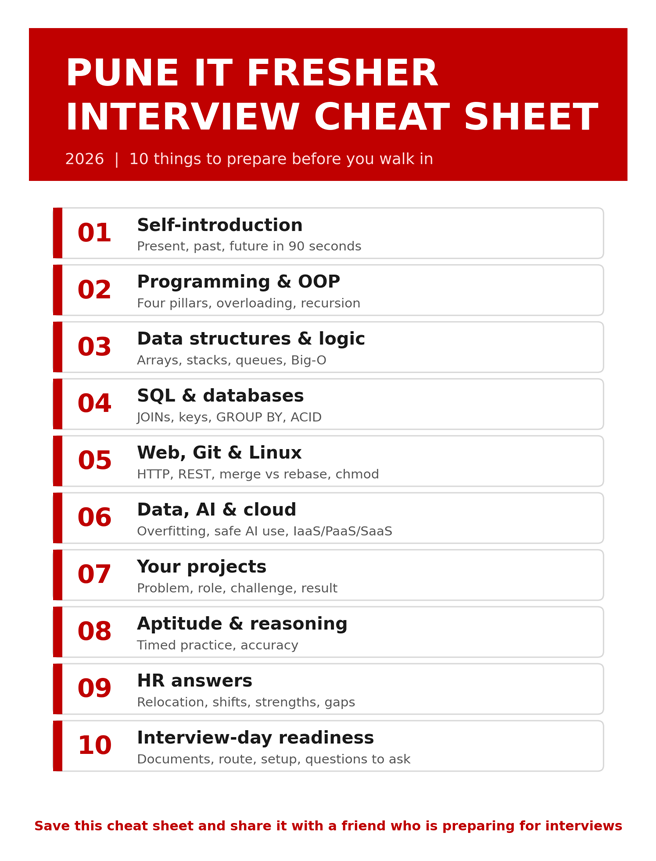
• How Pune IT hiring works and what interviewers here often ask
• The interview process, round by round
• Technical questions with model answers: programming, SQL, web, Git, data, AI and cloud
• Language-specific (Java and Python), operating system and resume-based questions
• What to do when you freeze or get stuck in an interview
• How to explain your projects, with a full worked example
• HR and behavioural questions with sample answers
• Interview-day checklist, walk-in drive tips, scam warning, offer letter and salary advice
• A 14-day preparation plan, common mistakes and FAQs
Understanding Pune's IT Hiring Landscape
Pune's IT employment is spread across several clusters rather than one area. Public city IT guides commonly name Hinjewadi (Rajiv Gandhi Infotech Park), Kharadi (including EON Free Zone and World Trade Center), Magarpatta (Cybercity), Talawade IT Park and the Baner and Balewadi corridor.
Because offices are spread across the city, Pune interviews often include practical questions that freshers do not expect. Prepare a clear, honest answer for each of these:
• Location and commute: "Are you comfortable working from this location?" Know roughly how you will travel before you say yes.
• Relocation and shifts: If you are from outside Pune, be ready to explain where you will stay. Some roles involve shift or support hours, so ask early.
• Joining timeline: Be clear about your availability and any pending exams or backlogs.
Most interviews are conducted in English, and some interviewers may switch to Hindi or Marathi to put you at ease. Follow their lead, but keep your technical explanation precise and professional.
This guide does not quote salaries or company lists, because they change by year, role and source. Always check a company's official careers page for current openings and requirements.
How the Interview Process Works
Every company designs its own process, but many fresher hiring processes follow a similar path.
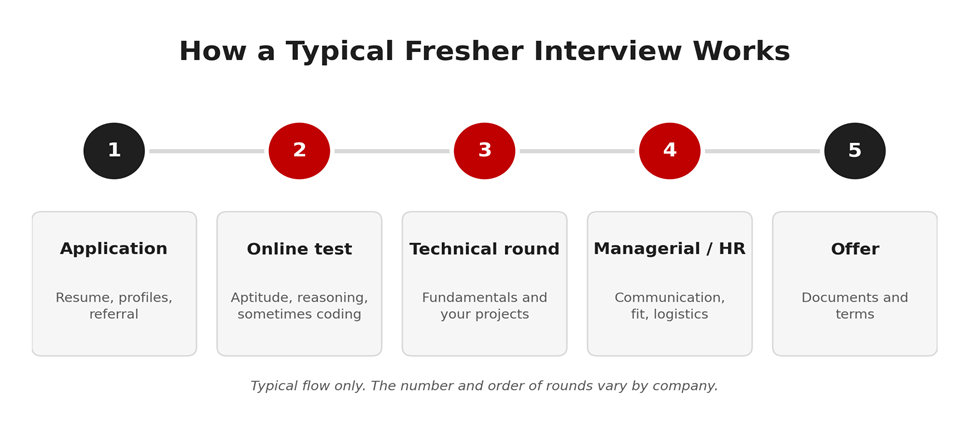
Online test. Usually aptitude, logical reasoning and verbal ability, sometimes with basic technical questions or coding. It is a filter, so speed and accuracy both matter.
Technical interview. A conversation about your fundamentals and your projects, sometimes with a short coding or logic problem. This is where most candidates are decided.
Managerial and HR round. Checks communication, attitude, teamwork and practical fit, including location, shifts and joining date.
Offer and documents. Verification of marks, identity and certificates, followed by the offer letter. Read it carefully before signing.
Round 1: The Aptitude and Online Test
Many freshers underestimate this round because it does not feel technical. But a weak score can end your application before any interviewer sees you.
• Practise short timed sets every day instead of long sessions once a week.
• Cover the common topics: percentages, ratios, time and work, number series, seating arrangements, syllogisms and reading comprehension.
• Do not spend too long on one question. Skip it and return if time allows.
• Check the platform requirements beforehand: browser, webcam, internet and a quiet room.
Round 2: The Technical Interview
Interviewers do not expect a fresher to know everything. They want clear fundamentals, honest answers and logical thinking. Explain in simple words, add a short example, and say so honestly when you are unsure.
Programming and OOP
Q1. What are the four pillars of OOP?
What they are checking: whether you understand the ideas, not just the names.
Strong answer: Object-oriented programming rests on four ideas. Encapsulation keeps data and the methods that work on it together inside a class and hides the internal details. A BankAccount class, for example, keeps the balance private and exposes only deposit() and withdraw(). Abstraction shows only what is necessary, like using an ATM without knowing how the bank's servers work. Inheritance lets one class reuse another's features, such as SavingsAccount extending Account. Polymorphism lets the same method behave differently for different objects, so calculateInterest() can work differently for savings and current accounts.
Q2. What is the difference between method overloading and overriding?
What they are checking: OOP depth and whether you can separate similar-sounding ideas.
Strong answer: Overloading means several methods in the same class share a name but have different parameters, and the correct one is chosen by the arguments. Overriding means a subclass provides its own version of a method already defined in its parent, so the behaviour changes depending on the actual object. Overloading is about different inputs; overriding is about different behaviour in a child class.
Q3. What is the difference between an array and a linked list?
What they are checking: basic data structure thinking and trade-offs.
Strong answer: An array stores elements in contiguous memory, so reading an element by index is very fast, but inserting in the middle requires shifting elements and the size is usually fixed. A linked list stores elements as nodes that point to the next one, so insertion and deletion are easy once you have the position, but reaching the nth element needs traversal. I would use an array when I need fast access by position and a linked list when I insert or delete often.
Q4. What is the difference between a stack and a queue?
What they are checking: whether you connect concepts to real use.
Strong answer: A stack is last in, first out, like a pile of plates: the last plate placed is the first removed. The undo feature in an editor uses a stack. A queue is first in, first out, like people waiting at a counter. A printer queue is a good example.
Q5. What is recursion?
What they are checking: logic and awareness of risk.
Strong answer: Recursion is when a function calls itself to solve a smaller version of the same problem. It needs a base case that stops the calls, otherwise it runs until the program runs out of stack memory. For example, factorial(n) returns n multiplied by factorial(n minus 1), and factorial(0) returns 1 as the base case.
Q6. What is time complexity?
What they are checking: whether you think about efficiency.
Strong answer: Time complexity describes how the running time of an algorithm grows as the input grows. Linear search checks items one by one, so it is O(n). Binary search halves a sorted list each step, so it is O(log n). For one million items, that is roughly the difference between a million checks and about twenty.
Language-Specific Questions (Java and Python)
Interviewers usually ask about the language on your resume. Revise the questions for the language you listed, and do not list a language you cannot discuss.
Q7. What is the difference between an abstract class and an interface in Java?
What they are checking: whether you know when to use each, not just the definitions.
Strong answer: An abstract class can have both abstract and concrete methods and can hold state, but a class can extend only one. An interface defines a contract of methods that classes agree to implement, and a class can implement many interfaces. I use an abstract class when related classes share common code and data, and an interface when unrelated classes need to follow the same behaviour, such as Payable or Printable.
Q8. What is the difference between "==" and equals() in Java?
Strong answer: "==" compares references, meaning whether two variables point to the same object. equals() compares content when a class overrides it. For strings, two separate String objects with the same text are not "==" equal but are equals() equal, so I always use equals() to compare string values.
Q9. Why are Strings immutable in Java?
Strong answer: Once created, a String cannot be changed. This makes strings safe to share between threads, lets Java reuse them from the string pool to save memory, and keeps them safe as keys in hash-based collections. When I need many modifications, I use StringBuilder instead.
Q10. What is the difference between a list, a tuple, a set and a dictionary in Python?
Strong answer: A list is ordered and mutable, so I can add, remove or change items. A tuple is ordered but immutable, which suits fixed data such as coordinates. A set stores unique items with no duplicates, and a dictionary stores key-value pairs with fast lookup by key. I choose based on whether the data changes, must be unique or needs lookup by name.
Q11. How does exception handling work?
Strong answer: Exception handling lets a program deal with runtime errors without crashing. In Python I use try, except and finally; in Java, try, catch and finally. The finally block runs whether or not an error occurred, so it is where I close files or connections. I catch specific exceptions instead of a generic one, so real bugs are not hidden.
Coding and Logic Problems
Many fresher interviews include one or two short problems. You are rarely judged on perfect syntax. You are judged on how you think. Use this four-step habit every time:
1. Clarify. Repeat the problem and ask about edge cases, such as empty input or capital letters.
2. Give an example. Walk through a small input by hand.
3. Explain your approach before writing code, and mention its time complexity.
4. Write and test. Run your example through the code and check one edge case.
Here is a worked example. The question: check whether a string is a palindrome.
Approach: compare the first and last characters, then move inward. If any pair differs, it is not a palindrome. This takes one pass, so the time complexity is O(n) with no extra memory.
def is_palindrome(s):
s = s.lower()
left, right = 0, len(s) - 1
while left < right:
if s[left] != s[right]:
return False
left += 1
right -= 1
return True
print(is_palindrome("Level")) # True
print(is_palindrome("Pune")) # False
A good interviewer will follow up: "What if the string has spaces or punctuation?" A strong reply is that you would first clean the string and keep only letters and digits before comparing.
Another favourite is FizzBuzz: print the numbers from 1 to 100, but print "Fizz" for multiples of 3, "Buzz" for multiples of 5 and "FizzBuzz" for multiples of both. The common mistake is checking 3 and 5 before the combined case, so check the combined case first.
for i in range(1, 101):
if i % 15 == 0:
print("FizzBuzz")
elif i % 3 == 0:
print("Fizz")
elif i % 5 == 0:
print("Buzz")
else:
print(i)
Practice set: reverse a string, Fibonacci series, FizzBuzz, find duplicates in an array, check a prime number, check anagrams and find the largest element. If you can explain these eight clearly, you are covered for most fresher rounds.
SQL and Databases
SQL appears in developer, tester, analyst and support interviews. The examples below use two simple tables: employees (id, name, department, salary) and customers and orders.
Q12. What is the difference between INNER JOIN and LEFT JOIN?
What they are checking: whether you have actually written joins.
Strong answer: INNER JOIN returns only rows that have a match in both tables. LEFT JOIN returns every row from the left table, and where there is no match, the right-side columns show NULL. For example, to list customers who have never placed an order, I would use a LEFT JOIN and filter for NULL.
SELECT c.name
FROM customers c
LEFT JOIN orders o ON c.id = o.customer_id
WHERE o.id IS NULL;
Q13. What is the difference between WHERE and HAVING?
Strong answer: WHERE filters individual rows before grouping, while HAVING filters groups after aggregation. To find departments with more than five employees, I group first and then use HAVING.
SELECT department, COUNT(*) AS total
FROM employees
GROUP BY department
HAVING COUNT(*) > 5;
Q14. How do you find the second highest salary?
What they are checking: problem-solving, and whether you consider duplicates.
Strong answer: One simple way is to take the maximum salary that is smaller than the overall maximum. This also handles duplicate top salaries correctly. Another way is to rank salaries with DENSE_RANK and pick rank two.
SELECT MAX(salary)
FROM employees
WHERE salary < (SELECT MAX(salary) FROM employees);
Q15. What are primary and foreign keys?
Strong answer: A primary key uniquely identifies each row in a table and cannot be null. A foreign key is a column that refers to the primary key of another table, which links the two tables and keeps the data consistent. In orders, customer_id is a foreign key pointing to customers.id.
Q16. What is normalisation, and what are ACID properties?
Strong answer: Normalisation organises data into related tables to reduce duplication and update problems. ACID describes reliable transactions: Atomicity (all steps happen or none), Consistency (data stays valid), Isolation (transactions do not interfere) and Durability (committed data survives a crash). A bank transfer is a good example: the debit and credit must both succeed or both fail.
Q17. What is the difference between DELETE, TRUNCATE and DROP?
Strong answer: DELETE removes selected rows and can use a WHERE condition. TRUNCATE removes all rows quickly but keeps the table structure. DROP removes the table itself.
Web, Git, Linux and Networking
Q18. What happens when you type a URL into a browser?
What they are checking: end-to-end thinking.
Strong answer: The browser first looks up the domain name through DNS to find the server's IP address. It then opens a connection, and for HTTPS it sets up an encrypted session. It sends an HTTP request, the server processes it and returns a response, and the browser renders the HTML, CSS and JavaScript into the page you see.
Q19. What is the difference between GET and POST?
Strong answer: GET is used to retrieve data and sends its parameters in the URL, so it should never carry sensitive information. POST sends data in the request body and is used to create or submit data, such as a login form or a new order.
Q20. What is a REST API?
Strong answer: A REST API lets applications talk over HTTP using standard methods on resources. For example, GET /students returns students, POST /students creates one, PUT /students/5 updates student five and DELETE /students/5 removes it. Responses usually come back as JSON.
Q21. What is the difference between "==" and "===" in JavaScript?
Strong answer: "==" compares values after converting their types, so 5 == "5" is true. "===" compares both value and type, so 5 === "5" is false. I prefer "===" because it avoids surprising conversions.
Q22. What is the difference between Git merge and rebase, and how do you resolve a conflict?
Strong answer: Merge combines two branches and keeps both histories with a merge commit. Rebase replays your commits on top of another branch, giving a cleaner, linear history. When a conflict occurs, Git marks the clashing lines in the file; I open it, decide which changes to keep, remove the markers, stage the file and continue the merge or rebase. I avoid rebasing branches that others already use.
Q23. Name a few Linux commands you use, and explain chmod.
Strong answer: I use ls to list files, cd to change directory, grep to search text, cat to view a file and ps to see processes. chmod changes file permissions for the owner, group and others, for example chmod 755 script.sh lets the owner read, write and execute while others can read and execute.
Operating System and Computer Fundamentals
Q24. What is the difference between a process and a thread?
Strong answer: A process is a running program with its own memory space. A thread is a smaller unit of execution inside a process, and threads of the same process share its memory. Threads are lighter and communicate easily, but shared memory means you must be careful about conflicts between them.
Q25. What is a deadlock?
Strong answer: A deadlock happens when two or more processes each wait for a resource held by another, so none can proceed. For example, process A holds resource 1 and waits for resource 2, while process B holds resource 2 and waits for resource 1. It can be avoided by acquiring resources in a fixed order or by using timeouts.
Q26. What is the difference between a compiler and an interpreter?
Strong answer: A compiler translates the whole program into machine-level code before it runs, which usually makes execution faster. An interpreter translates and runs the code step by step, which makes testing easier but is usually slower. Java is compiled to bytecode and run on the JVM, while Python is commonly run through an interpreter.
Q27. What is the difference between stack and heap memory?
Strong answer: Stack memory holds method calls and local variables and is cleaned up automatically when a method ends. Heap memory holds objects and stays until it is no longer used. Very deep recursion can fill the stack and cause a stack overflow.
Data, AI and Cloud
Q28. What is overfitting?
Strong answer: Overfitting happens when a model learns the training data too closely, including its noise, so it performs well on training data but poorly on new data. I would check for it by comparing training and test performance, and reduce it with more data, a simpler model or regularisation.
Q29. What is the difference between supervised and unsupervised learning?
Strong answer: Supervised learning trains on labelled data, such as emails marked spam or not spam, to predict labels for new data. Unsupervised learning finds patterns in unlabelled data, such as grouping customers by behaviour.
Q30. How do you handle missing values in a dataset?
Strong answer: It depends on how much is missing and why. If very little is missing, I may remove those rows. Otherwise I fill them with the mean or median for numbers or the most frequent value for categories, and I check that the fix does not distort the results.
Q31. How do you use AI tools in your work or studies?
What they are checking: maturity and responsible use. This question is now very common.
Strong answer: I use AI as a helper for drafts, explanations and debugging ideas, not as a replacement for understanding. I always read and test what it gives me, because it can be confidently wrong. I also do not paste confidential or personal data into public tools. For example, when I used it to suggest a query for my project, I ran it on sample data and fixed one join it got wrong.
Q32. What are IaaS, PaaS and SaaS?
Strong answer: IaaS gives you raw infrastructure such as virtual machines, like AWS EC2. PaaS gives you a platform to deploy applications without managing servers, like a managed app service. SaaS is ready-to-use software delivered over the internet, like Gmail.
Software Testing (for QA Roles)
Q33. What is the difference between smoke and sanity testing?
Strong answer: Smoke testing is a quick check that a new build is stable enough for deeper testing, for example whether the app launches and login works. Sanity testing is a narrow check after a small change or fix to confirm that the specific issue is resolved without breaking related behaviour.
Q34. What makes a good bug report?
Strong answer: A clear title, the steps to reproduce, the expected result, the actual result, the environment, the severity and a screenshot or log. A good bug report lets a developer reproduce the problem without asking you anything.
What to Do When You Freeze or Get Stuck
Every fresher goes blank at some point. It does not end the interview. How you recover is part of what is being judged, and calm recovery often impresses more than a perfect answer.
• Pause and breathe. A three-second pause looks thoughtful, not weak.
• Repeat the question in your own words. It buys time and confirms you understood it.
• Think aloud. Say what you do know, even if it is only a related idea. Interviewers often guide you from there.
• Ask politely for clarity. "Could I confirm whether you mean X or Y?" is perfectly acceptable.
• Be honest. Admit what you have not worked with and explain how you would find out.
• Move on. One weak answer rarely decides an interview. Do not carry it into the next question.
|
A recovery line that works "I am not completely sure, but here is how I would work it out..." Then reason step by step. This shows honesty and problem-solving, which is what the interviewer wants to see. |
Your Projects: Where Interviews Are Won or Lost
Almost every technical interview includes questions about your projects. This is where interviewers check whether the work is really yours. If you cannot explain your own project, the rest of your resume loses credibility.
Use the five-part structure below to prepare a two-minute explanation for every project on your resume.
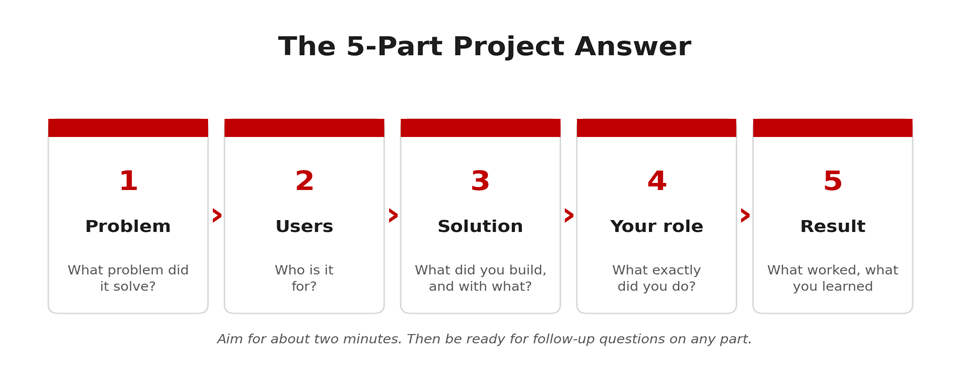
Figure: The 5-part project answer
|
Worked example: "Explain your project" (replace with your own details) Problem: "In our college, attendance was recorded on paper, which took time and was easy to get wrong." Users: "The users are teachers, who mark attendance, and students, who view their records." Solution: "I built a web application with Spring Boot and MySQL. Teachers log in, select a class and mark attendance, and students can view their percentage." My role: "I was part of a team of four. I built the backend APIs and the database design, and I wrote the attendance calculation." Result and learning: "We tested it with sample data for one class. The hardest part was a login bug caused by token expiry. I fixed it and added tests for expiry cases. If I had more time, I would add role-based access and email alerts." |
Be ready for follow-up questions on any part of it:
• Why did you choose this technology instead of another?
• Can you draw the database tables and explain their relationships?
• What was the hardest bug, and how did you find it?
• How did you test it, and what would you change if you rebuilt it?
• Which part did you personally write, and can you walk me through that code?
Pre-interview drill: open each project and ask yourself whether you can explain every table, every API and one failure with its fix. If you cannot, revise that part before the interview.
Resume-Based Questions: Anything Listed Can Be Asked
Interviewers often pick questions straight from your resume. Every skill, certificate, internship and even hobby can become a question, so go through your resume line by line before the interview.
• Skills: expect "How would you rate yourself in this, and why?" Rate yourself honestly and back it with something you built.
• Certifications: be ready to explain what you learned and what you actually used.
• Internships or training: know your tasks, the tools and one problem you solved.
• Achievements: have the story behind each one ready in two or three sentences.
• Hobbies: be able to speak about each for a minute. A genuine answer helps the conversation feel natural.
|
Example: "Rate your Python" (replace with your own honest answer) "About seven out of ten. I am comfortable with functions, lists, dictionaries and file handling, and I have used Python in two projects, including [project name]. I am still learning topics like decorators and testing frameworks, and I am working on them." |
The HR Round: Questions and Sample Answers
Do not treat HR questions as easy. Many freshers lose offers here because their answers are rambling, memorised or vague. Prepare short, honest answers and practise them aloud.
Q35. Tell me about yourself.
What they are checking: communication and relevance. Use Present, Past, Future and keep it to about 90 seconds.
|
Sample answer (replace the details in brackets with your own) "Good morning. I am [name], and I recently completed my [degree] from [college] in Pune. I work mainly with [language] and [SQL / web tools], and my final-year project was [one-line description]. I became interested in software when [short, true reason], and since then I have practised regularly and built [number] projects. Now I am looking for a [role] where I can learn from an experienced team and take on real responsibility. I applied to your company because [one specific reason]." |
Q36. Why do you want to join this company?
Generic praise is the most common mistake. Compare these two answers:
|
Weak Answer |
Strong Answer |
|
"It is a reputed company and I want to grow." |
"I read that your team works on [domain from the careers page]. My project used [related technology], and I would like to work on similar problems at larger scale." |
|
"I am hardworking." (when asked about strengths) |
"I learn by building. I picked up [tool] in a few weeks by rebuilding my own project, and I can show it." |
|
"I am a perfectionist." (when asked about weaknesses) |
"I used to spend too long stuck on a bug. Now I give myself thirty minutes and then ask for help." |
Q37. What are your strengths and weaknesses?
Strong answer: Name a real strength with a short example, and a real weakness with the specific step you are taking to improve it. Avoid fake weaknesses such as "I work too hard", because interviewers hear them constantly and distrust them.
Q38. Where do you see yourself in five years?
Strong answer: "In five years I want to be a skilled developer who owns features end to end and helps newer team members. In the first year I want to learn the company's tools and standards well." Talk about growth in skills and responsibility, not about a specific title.
Q39. Why should we hire you?
Strong answer: Pick two or three points from the job description and match each to something you have actually done. For example: "You need someone with Java and SQL. I have built two projects with both, and I can explain the design. I also learn quickly and I take feedback well."
Q40. Are you comfortable with relocation, shifts or working from this location?
Strong answer: Answer honestly and clearly. If you are comfortable, say so and mention how you will manage it. If you have a constraint, state it calmly instead of promising something you cannot do. Interviewers respect clarity more than a forced yes.
Q41. Do you have any backlogs or a gap in your education?
Strong answer: State the fact briefly, give the reason in one or two sentences without blame, and finish with what you did to improve, such as clearing the subjects or building skills during the gap. Stay calm and do not become defensive.
Q42. What are your salary expectations?
Strong answer: Do not invent a number. A good reply is: "I would like to understand the role and the compensation structure first. I expect a fair offer in line with the role, and I am open to the company's standard fresher structure." Ask about the components, such as fixed pay, variable pay and benefits.
Q43. What do you know about our company?
What they are checking: whether you did even basic research.
Strong answer: Spend twenty minutes on the company's website, careers page and recent news before the interview. Prepare three facts: what the company does, one domain or product, and one thing that interests you. For example: "You work in [domain], and the role I applied for uses [technology], which matches my project work."
Q44. How do you handle pressure or criticism?
Strong answer: Treat feedback as information, not as an attack. For example: "My mentor pointed out that my code had no tests. I felt defensive for a moment, but I added tests, and my next review had far fewer issues. Under pressure, I break the work into smaller steps and do the most important one first." Use a real example of your own.
Q45. Are you a team player?
Strong answer: Give a specific example instead of saying yes. For example: "In our team of four, a teammate was struggling with the database design, so I spent an evening helping him. We finished the module earlier and the design was stronger." Mention what the team achieved, not only what you did.
Behavioural Questions and the STAR Method
Managers use behavioural questions to learn how you act under pressure. Use STAR: Situation, Task, Action, Result. It keeps your answer short, structured and honest.
Q46. Tell me about a time you faced a tight deadline.
|
Worked STAR example (adapt to your own experience) Situation: "Five days before our final-year project demo, the login module failed intermittently." Task: "I was responsible for the backend authentication, so I had to fix it before the demo." Action: "I reproduced the problem using logs, found that the token expired earlier than expected, fixed the logic, wrote tests for expiry cases and told my team early about the risk." Result: "The demo went smoothly. Since then I add edge-case tests early instead of leaving them until the end." |
Prepare three stories in advance from your college life: a deadline, a disagreement in a team and a mistake you learned from. Most behavioural questions can be answered with one of these three.
Interview-Day Checklist for Pune
A well-prepared candidate can still lose points by arriving late or without the right documents. Check your invitation for the exact list, and use this as a guide.
• Printed copies of your resume, and a notebook and pen
• A government photo ID (carry the one the invitation requests)
• Mark sheets, degree or provisional certificate, and any certificates listed on your resume
• Passport-size photographs if requested, and the interview invitation with contact details
• Route: plan it in advance. IT park areas can see heavy traffic at peak hours, so leave early and aim to arrive 15 to 20 minutes before your slot
• Dress: clean, simple and professional. When in doubt, choose smart formal wear
• Virtual interviews: test your camera, microphone and internet, and sit in a quiet, well-lit space
Walk-In Interviews and Hiring Drives
Walk-in drives are common in Pune's IT areas. They can be crowded and long, so a little preparation makes a big difference.
• Arrive early. Queues can form quickly and early candidates are often seen first.
• Carry several resume copies, photographs, ID and certificates in a neat folder.
• Dress as you would for a formal interview, even if the drive feels informal.
• Be patient and polite with reception and HR staff. They notice how candidates behave.
• Carry water, a charged phone and a power bank, since waiting can be long.
• Before leaving, ask what the next step is and when you can expect an update.
• Confirm that the walk-in notice came from the company's official channel before you go.
Beware of Fake Job Offers
Fresher job seekers are often targeted by fraudulent messages. A genuine employer does not ask you to pay money for an interview, training, a laptop or a "security deposit". Confirm every opening on the company's official careers page before sharing documents, be careful with offers from free email addresses or messaging apps, and never share OTPs, bank details or passwords with a "recruiter". If something feels wrong, check with your college placement cell before replying.
Offer Letter and Salary: What to Check
When an offer arrives, read every line before you sign. Check the job title, work location, joining date, probation and notice period, any service agreement or bond, and the compensation breakup between fixed pay, variable pay and benefits. If anything is unclear, ask politely in writing and keep the replies. A genuine company will answer these questions without pressure.
Your 14-Day Preparation Plan
If you have two weeks, this plan keeps your preparation balanced. Study for one to two hours a day and adjust it to your target role.
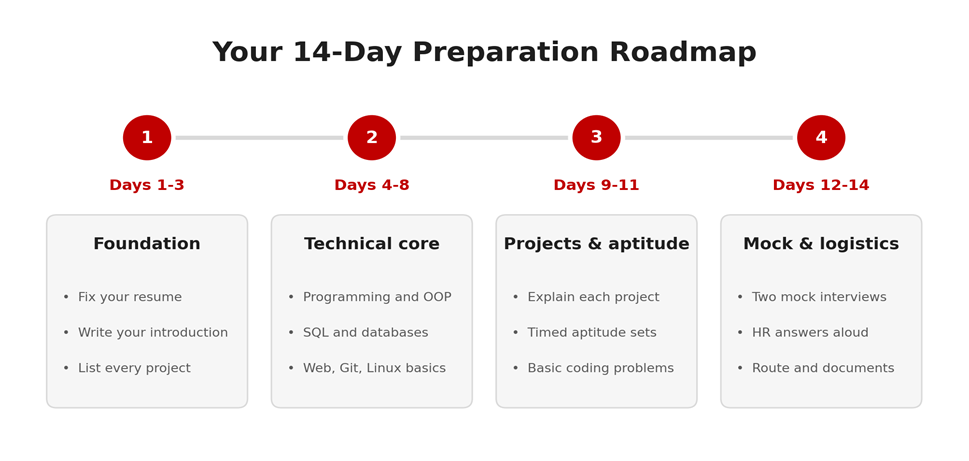
Days 1 to 3, Foundation. Fix your resume, write your 90-second introduction and list every project with its tools and your role.
Days 4 to 8, Technical core. Revise programming and OOP, SQL and databases, and the web, Git and Linux basics. Keep a notebook of short answers in your own words.
Days 9 to 11, Projects and aptitude. Practise explaining each project aloud, do timed aptitude sets and solve the basic coding problems from this guide.
Days 12 to 14, Mock and logistics. Do two mock interviews with a friend or mentor, rehearse your HR answers and get your documents and route ready.
The Final 24 Hours Before Your Interview
The last day is for confidence, not cramming. Do these in order:
1. Revise your notebook of short answers. Do not start new topics now.
2. Rehearse your introduction and one project aloud, twice.
3. Check your documents, route and travel time, and keep a backup plan.
4. Keep your outfit ready and your phone charged.
5. Re-read the job description and the company's careers page.
6. Sleep well. A rested mind answers better than one that studied all night.
7. Eat before you leave, and aim to arrive 15 to 20 minutes early.
Common Mistakes That Cost Freshers Offers
• Memorising answers word for word. Follow-up questions expose it immediately.
• Listing skills you cannot discuss. Anything on your resume can be asked.
• Guessing confidently. "I am not sure, but I would approach it by..." is better than a wrong, confident answer.
• Speaking negatively about a previous college, team or company.
• Arriving late or unprepared. It shows attitude before you speak.
• Having no questions. It can look like low interest.
• Skipping the follow-up. A short thank-you message to the recruiter is a good habit.
Questions You Should Ask the Interviewer
At the end you will usually hear, "Do you have any questions?" Prepare two or three:
• What does onboarding or training look like for new freshers?
• What kind of projects or technologies would I work on in my first six months?
• How is the performance of a new joiner usually reviewed?
• What skills would you suggest I strengthen before joining?
Avoid asking only about salary, leave or working hours in a first technical interview.
After the Interview
Write down every question you were asked while it is fresh. This becomes your best study material. Send a brief, polite thank-you message to the recruiter if you have their contact, and record the date and expected response time in a simple tracking sheet. If you hear nothing after the stated timeline, send one polite follow-up. Then improve one weak area before the next interview, whatever the result.
Where Structured Guidance Can Help
Self-study works for many freshers, but it is hard to judge your own interview answers. If you would like guided support, a learning centre such as upGrad Learning Support Centre, Pune can be a useful next step to explore, especially for Pune-based learners who prefer structured practice.
Structured programmes in areas like data, AI/ML, full stack development and digital marketing generally combine a planned curriculum, hands-on projects, mentor guidance and interview preparation. Those are the things this guide asks of you: strong fundamentals, project depth and confident communication. Course content, fees, schedules and eligibility can change, so confirm the latest details directly with the centre.
Before joining any programme, ask whether you will build real projects and get feedback on them, whether mock interviews and resume reviews are included, and whether the curriculum matches what employers ask for today. Be cautious about anyone who guarantees a job, interviews or a salary, because nobody can honestly promise that.
Get Regular Job Updates
Looking for regular IT job updates, fresher opportunities, and career-related updates? Join our WhatsApp group for more job updates and opportunities.
Join our WhatsApp Group: https://chat.whatsapp.com/KA8HpgjbJ67I5yfQDquCvn
Frequently Asked Questions (FAQs)
Q. What are the most common interview questions for IT freshers in Pune?
Expect "Tell me about yourself", questions on OOP, SQL and your projects, a few basic coding problems, and HR questions about relocation, shifts and joining date. The exact questions vary by company and role.
Q. How can I prepare for an IT interview in 7 days?
Spend days one and two on your resume and introduction, days three to five on programming, SQL and web basics, day six on your projects and aptitude, and day seven on a mock interview and logistics.
Q. Is DSA compulsory for IT fresher interviews?
It depends on the company and role. Many service and support roles focus on fundamentals, while product-oriented roles may test data structures and algorithms in more depth. Check the job description and prepare accordingly.
Q. What should I wear to an IT interview in Pune?
Clean, simple, professional clothing is a safe choice. Smart formal wear works for most interviews unless the invitation states a different dress code.
Q. How do I answer if I have no work experience?
Talk about your projects, internships and learning. Show what you built or solved, what went wrong and what you learned. Interviewers hiring freshers expect this.
Q. How do I find fresher openings in Pune?
Use company careers pages, job portals, professional networking sites, your college placement cell and referrals. Verify every opening before sharing personal details.
Q. What if I do not know the answer to a technical question?
Say so honestly and explain how you would approach it. Interviewers value clear thinking and honesty more than a confident wrong answer.
Conclusion
Strong preparation for interview questions for IT freshers in Pune comes down to four things: clear fundamentals, projects you can explain, honest and practised HR answers, and good preparation for the interview day. None of them needs a special background. They need a plan and regular practice.
Your next step is simple. Start the 14-day plan today: fix your resume, write your introduction and rehearse your projects aloud. If you want mentor feedback and mock interview practice, you can also explore what upGrad Learning Support Centre, Pune offers for your chosen path.
And if you want regular job and fresher opportunity updates, use the WhatsApp group link in the "Get Regular Job Updates" section above.